Summary
This paper asks how deeply the collapse of shared factual reality has affected democracy in the United States. It argues that democratic erosion unfolds through three interconnected stages: declining trust in institutions, experts, media, and fellow citizens; deepening affective polarization; and growing tolerance for authoritarian or anti-democratic conduct. It concludes that these forces have affected American democracy to a regime-redefining degree, shifting the United States from a healthy liberal democracy into a weak but real authoritarian form.
In this paper, the word "liberal" refers to classical liberalism or small-l liberalism: a political philosophy centered on individual liberty, consent of the governed, equality before the law, limited government, and free markets. it does not use the term in the common American sense of referring to the political left or the Democratic Party.
Introduction
American democracy depends on something more basic than institutions or laws: a shared agreement about fundamental reality. When a nation’s citizens can no longer agree on what is true, democratic processes become difficult to sustain. This is referred to as the collapse of “shared factual reality.” This describes the behavior where individuals rely on different and often incompatible sources of information leading to what Jones and Chandrasekharan call “testimonial sabotage” which undermines trust in knowledge itself. Citizens become less able to evaluate political claims, far less willing to accept opposing worldviews, and are more likely to dismiss institutions that contradict preferred narratives.Dominic Zaun Eu Jones and Eshwar Chandrasekharan, “Measuring Epistemic Trust: Towards a New Lens for Democratic Legitimacy, Misinformation, and Echo Chambers,” Proceedings of the ACM on Human-Computer Interaction 8, no. CSCW2 (2024): 2, https://doi.org/10.1145/3687001.
This epistemic breakdown has significant consequences in the United States. Democracy relies not only on formal rules but also on public commitment to democratic norms such as fair elections, civil liberties, and the rule of law. However, this commitment appears increasingly fragile in recent years. Research by Graham and Svolik shows that while most Americans claim to support democracy in principle, many are willing to abandon democratic norms when they conflict with partisan interests.Matthew H. Graham and Milan W. Svolik, “Democracy in America? Partisanship, Polarization, and the Robustness of Support for Democracy in the United States,” American Political Science Review 114, no. 2 (2020): 392, https://doi.org/10.1017/S0003055420000052. In reality, only a small portion of voters consistently prioritize democratic principles over party loyalty, this suggests that public support for democracy may be weaker than previously thought. This raises a particular concern: if citizens are unwilling to defend democratic norms when it matters, democratic institutions and democracy itself may become vulnerable.
This paper raises the question: To what degree has the collapse of shared factual reality affected democracy in the United States? Instead of treating democratic decline as a single event, this paper adopts a staged framework looking at how epistemic breakdown produces political consequences. Specifically, through three successive stages: the erosion of trust, deepening political polarization, and the rise of authoritarian tendencies.
The First stage deals with the erosion of trust. Trust is a fundamental component of democratic governance, it allows citizens to accept decisions, comply with laws, and engage with institutions despite uncertainty. With this in mind, trust in the United States has declined significantly over the past decades, causing growing cynicism and disengagement, “It is beyond dispute that Americans’ trust in their national government has declined over the past 50 years.”Jack Citrin and Laura Stoker, “Political Trust in a Cynical Age,” Annual Review of Political Science 21, no. 1 (2018): 50, https://doi.org/10.1146/annurev-polisci-050316-092550. When citizens no longer trust institutions such as elections, courts, or the media, they are less likely to view outcomes as legitimate. Furthermore, there appears to be a partisan gap when it comes to trust and “There is now almost no trust in government among partisans of the out-party.” Citrin and Stoker, “Political Trust in a Cynical Age,” 53.
The second stage dives into the deepening political polarization we have been witnessing in the past decades. As shared facts disappear, citizens are increasingly likely to rely on partisan identities to interpret political information. This leads to a rise in “affective polarization” where citizens do not just disagree on issues but hold strong negative feelings, distrust, or animosity towards members of opposing political groups and positive, trusting feelings towards their own political group. In Origins and Consequences of Affective Polarization, this is best summarized as “Americans increasingly dislike and distrust those from the other party.”Shanto Iyengar et al., “The Origins and Consequences of Affective Polarization in the United States,” Annual Review of Political Science 22, no. 1 (2019): 129, https://doi.org/10.1146/annurev-polisci-051117-073034. Furthermore, “Democrats and Republicans both say that the other party’s members are hypocritical, selfish, and closed-minded, and they are unwilling to socialize across party lines.”Iyengar et al., “The Origins and Consequences of Affective Polarization in the United States,” 131. This shift makes political competition a zero-sum game, making compromise more difficult and increasing the stakes of elections.
The final stage is the rise of authoritarian tendencies. When trust is low and polarization is high, citizens may become more willing to support leaders who promise order, stability, or victory over political opponents, even at the expense of democratic norms. Juan J. Linz and Alfred Stepan define authoritarian regimes as “political systems with limited, not responsible, political pluralism, without elaborate and guiding ideology, but with distinctive mentalities, without extensive nor intensive political mobilization, except at some points in their development, and in which a leader or occasionally a small group exercises power within formally ill-defined limits but actually quite predictable ones."Juan Linz, Problems of Democratic Transition and Consolidation (Johns Hopkins University Press, 1996), 38, https://doi.org/10.56021/9780801851575. While the United States remains a democracy, the conditions described in earlier stages, declining trust, and increasing polarization, create openings for political actors who challenge democratic rules and institutions.
Altogether these stages suggest that the collapse of shared factual reality is a starting point for a broader process of democratic erosion. Epistemic breakdown weakens trust, which fuels polarization, and creates conditions in which authoritarian tendencies can emerge. This framework provides a structured way to understand how changes in information and the belief systems translate into political consequences.
I · The erosion of trust
The first stage in the effects we see due to the collapse of shared factual reality is the erosion of trust. While elections, institutions, and civil procedures are core to democracy, so is the willingness of citizens to trust these democratic norms. Democracy depends on citizens’ ability to treat other people, experts, media sources, and public institutions as at least--- potentially credible. Jones and Chandrasekharan write “Trust is crucial for the functioning of complex societies,” because “Most of my knowledge and beliefs will be ultimately underwritten by testimony. It is, as a general rule, impossible to travel to every corner of the world and perceive first-hand all events. We are dependent on each other”Jones and Chandrasekharan, “Measuring Epistemic Trust,” 2. In everyday life citizens cannot personally verify most of the claims that shape politics. They must rely on testimony given by others, which makes credibility central to public knowledge. For that reason, Jones and Chandrasekharan define “epistemic trust” or “testimonial credibility” as the willingness to accept a speaker’s claim based on beliefs about that speaker’s competence or sincerity.Jones and Chandrasekharan, “Measuring Epistemic Trust,” 4. Once this kind of trust breaks down, a shared reality that is necessary for democratic debate/deliberation becomes much harder to sustain.
This problem deepens when citizens no longer share common truths and justification. Jones and Chandrasekharan argue that democratic legitimacy itself rests on epistemic foundations, because “justification relies on testimony.”Jones and Chandrasekharan, “Measuring Epistemic Trust,” 5. If citizens no longer trust the sources that help justify public decisions, then institutions themselves become hard to view as legitimate. Jones and Chandrasekharan also suggest that misinformation contributes to the loss of our fellow citizens as “epistemic equals,” meaning that disagreement no longer occur within a shared reality but across rival and distrusting realities.Jones and Chandrasekharan, “Measuring Epistemic Trust,” 6. In this environment political opponents are less likely to be seen as mistaken fellow citizens but are seen as irrational, manipulated, “indoctrinated” or dishonest. Resulting not solely in disagreement, but a division of the public.
In the United States, this epistemic breakdown has also coincided with a sharp decline in political trust. As mentioned previously, Citrin and Stoker describe a decades long decline in political trust.Citrin and Stoker, “Political Trust in a Cynical Age,” 50. This is crucial to understand for when citizens no longer see government as competent, fair, and acting in the public interest, democratic legitimacy and stability weakens while cynicism and fragility grow. This decline in trust has also become strongly partisan. Citrin and Stoker argue that “Partisan variations in trust in government are not new. The puzzle is why they are growing.”Citrin and Stoker, “Political Trust in a Cynical Age,” 57. And further, trust, increasingly depends on whether one’s own party holds power. Trust in government has become less a judgment on institutions themselves and more of a signal of one’s partisan loyalty. This shift is dangerous in any political system because it weakens shared standards for evaluating institutions and encourages citizens to trust or distrust depending on which side benefits.
Disinformation further intensifies this erosion by actively destabilizing our information environments. Humprecht and her coauthors define disinformation the “purposeful manipulation, decontextualization, or fabrication of untrue information to achieve a predefined political goal.”Edda Humprecht et al., “The Sharing of Disinformation of Resilience,” Information, Communication & Society 26, no. 7 (2023): 1342, https://doi.org/10.1080/1369118X.2021.2006744. They also argue that is often used to “fuel mistrust in the mainstream media and the established political order”Humprecht et al., “The Sharing of Disinformation” 1342. This definition is useful because it shows the delineation of misinformation as not just false or incorrect content. Instead, it is a tool used as a delegalizing force that pushes citizens to doubt the credibility of verifiable mainstream institutions and to treat established media and political order as fundamentally untrustworthy. “It is meant to incite hostility and cultivate divisions between social groups … which aims to control public opinion … by attributing blame out of manipulative intent.”Humprecht et al., “The Sharing of Disinformation” 1343. Zimmermann and Kohring reinforce this point by showing how mistrust is a mechanism through which disinformation gains creates political change. They found that lower trust in news media and politics increased belief in disinforming news, and this mistrust affected vote choice, alienated voters, and pushed voters towards right wing populist alternatives.Fabian Zimmermann and Matthias Kohring, “Mistrust, Disinforming News, and Vote Choice: A Panel Survey on the Origins and Consequences of Believing Disinformation in the 2017 German Parliamentary Election,” Political Communication 37, no. 2 (2020): 215–37, https://doi.org/10.1080/10584609.2019.1686095. Humprecht also shows that resilience to disinformation is weaker under certain conditions, such as when polarization, alternative media use, and heavy social media reliance, are more common. “Across all countries, populist party support, alternative media use, and the use of and activity on social media significantly lowered the intention to refrain from giving additional exposure to disinformation.”Humprecht et al., “The Sharing of Disinformation in Cross-National Comparison,” 1354. To rephrase, erosion of trust is not solely an individual problem, it is often reinforced by political and media conditions that makes citizens more vulnerable to falsehoods and epistemic destabilization. In the case of the United States, the collapse of shared factually reality weakens democracy by first corroding mutual trust that makes social political life possible. The erosion of trust does not remain confined to institutions alone. It also changes how citizens interpret one another and often gives way to polarization.
II · Affective polarization
The second stage we see is increasing political polarization, specifically affective political polarization as previously defined by Iyengar and his coauthors. This form of polarization is rooted not only in policy disagreement but is exacerbated through identity and emotion. As partisan identity becomes central to how citizens understand politics, hostilities towards the conflicting side intensify. Democrats and Republicans increasingly describe members of the other party as “hypocritical, selfish, and closed-minded.” Iyengar et al., “The Origins and Consequences of Affective Polarization in the United States,” 131. Further McCoy and Somer describe some of the dangers that come with polarization stating “polarizing politics always carries the risk of taking on a life of its own, eviscerating cross-cutting ties and nonpartisan channels for compromise, and becoming pernicious”Jennifer McCoy and Murat Somer, “Toward a Theory of Pernicious Polarization and How It Harms Democracies: Comparative Evidence and Possible Remedies,” The ANNALS of the American Academy of Political and Social Science 681, no. 1 (2019): 235, https://doi.org/10.1177/0002716218818782.
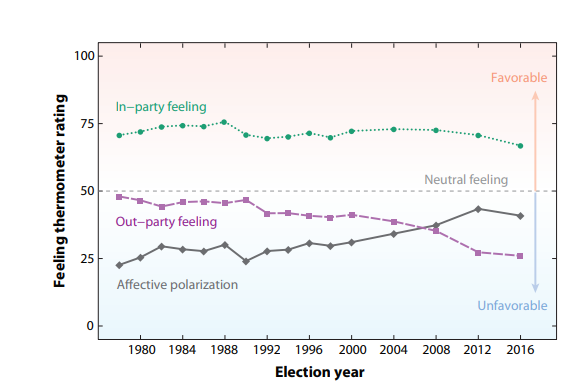
Growing partisan animosity matters because it weakens citizens’ commitment to democratic principles. Graham and Svolik argue that in a polarized system, many voters behave with the mindset “partisans first and democrats only second”Graham and Svolik, “Democracy in America?,” 393. Their research suggests that support for democracy is less robust in practice. They found that centrists are more likely than strong partisans to punish anti-democratic behavior. Among strong partisans the willingness to defend democratic rules drops sharply. In one of their most alarming findings only 13.1% of respondents were willing to punish co-partisan candidates if they were found to violate democratic norms, if they must vote against their own party.Graham and Svolik, “Democracy in America?,” 393. This illustrates that polarization not only divides citizens but it changes the standards citizens use to evaluate and punish anti-democratic transgressions.
Polarization also creates a partisan double standard in how democratic norm violations are judged. Graham and Svolik found that both Democrats and Republicans are more likely to punish anti-democratic behavior when it comes from the opposing party than when it comes to their own.Graham and Svolik, “Democracy in America?,” 393, 400–402. Citizens often do not apply standards consistently. The same behavior that looks excusable when one’s own side does it, becomes intolerable when the other side commits the same transgression. Recent evidence shows that tolerance for anti-democratic norm violations rises when one’s own party is in control of the presidency. Littvay, McCoy, and Simonovits find that support for executive concentration of power is consistently higher among supporters of the president’s party and that people whose preferred party hold power were 15.8% more likely to justify the president shutting down congress.Levente Littvay et al., “It’s Not Just Trump: Americans of Both Parties Support Liberal Democratic Norm Violations More Under Their Own President,” Public Opinion Quarterly 88, no. 3 (2024): 1044–48, https://doi.org/10.1093/poq/nfae042. And this dynamic becomes even more dangerous when democratic norms themselves are politicized. Kingzette and his coauthors argue that affective polarization “vitiates support for democratic norms” through elite cue-taking and out party biasJon Kingzette et al., “How Affective Polarization Undermines Support for Democratic Norms,” Public Opinion Quarterly 85, no. 2 (2021): 664–66, https://doi.org/10.1093/poq/nfab029. the authors summarize this behavior best, he says “elites in positions of power signal displeasure with norms limiting that power (e.g., checks and balances). This causes affectively polarized partisans to react based on whether their party is in power. Second, affective polarization may generate biases against the out-party that leads partisans from both parties to oppose norms requiring the fair treatment of all points of view”Kingzette et al., “How Affective Polarization Undermines Support for Democratic Norms,” 2. For example when one party controls the presidency, polarized supports of that party become less supportive of constitutional constraints on executive power, while affectively polarized opponents become more supportive of them. As the authors put it, norms stop looking like neutral democratic principles and instead become “rules that only apply to the other party.”Kingzette et al., “How Affective Polarization Undermines Support for Democratic Norms,” 665–66.
In Kingzette’s words, democratic principles increasingly have become “political fodder” rather than the core features of constitutional governmentKingzette et al., “How Affective Polarization Undermines Support for Democratic Norms,” 664. It also reduces support for political tolerance, where affectively polarized partisans come to see the other party as a threat, and become more willing to limit the other side’s ability to “vote, speak freely, and protest.”Kingzette et al., “How Affective Polarization Undermines Support for Democratic Norms,” 666. This reaches a point where polarization can no longer be described as intense competition within democracy. It becomes a mechanism through which citizens begin accepting unequal rights, selective rule enforcement, and weakened constitutional protections. Affective political polarization has become a major step in democratic erosion itself. At this point, the problem is no longer bitter disagreement between political groups. Once opponents are seen as threats, polarization begins to undermine basic democratic ideas.
III · Authoritarian tendencies
Moving to the third and final stage we investigate the rise of authoritarian tendencies using the definition previously provided by Linz and Stephan. This definition is important because it demonstrates that authoritarianism does not require the complete erasure of institutions and elections. It can emerge through narrowing pluralism, weakened accountability, and an expansion of executive or elite power beyond normal democratic constraints. Polarization nurtures the conditions for this shift. Bermeo is especially useful here, she shows that democratic backsliding in the modern era often occurs through gradual, legally cloaked, institutional weaking rather than sudden democratic collapse. She argues that coups and blatant election fraud have declined, while newer forms such as “executive aggrandizement” have become more common. This takes form when leaders weaken checks on executive power. This clarifies how authoritarian tendencies can emerge without the immediate abolition of elections or dissenting parties.Nancy Bermeo, “On Democratic Backsliding,” Journal of Democracy 27, no. 1 (2016): 5–6, 10–11, https://doi.org/10.1353/jod.2016.0012.
Looking at the United States today, Gardner is especially useful through connecting the broader literature on democratic backsliding to the present-day United States. He Writes that liberal democracy is “eroding rapidly around the globe, including in the United States,” and argues that the Republican Party has “drifted decisively toward populist authoritarianism.”James A. Gardner, “Can Federalism Protect Subnational Liberal Democracy from Central Authoritarianism?,” preprint, SSRN, 2024, 22–23, https://doi.org/10.2139/ssrn.4920024. Furthermore he warns that if backsliding continues the most likely outcomes for the United States is “some kind of competitive authoritarianism,” explaining a regime where elections exist but operate under increasingly unfair conditions with weakened democratic guarantees.Gardner, “Can Federalism Protect Subnational Liberal Democracy from Central Authoritarianism?,” 22, 27–28.
Looking at reports from democracy monitoring groups also confirms this. Freedom House gave the United States a score of 81/100 in Freedom in the World 2026, noting that the United States represented the largest decline in 2025 among the free countries. This decline is mainly due to “legislative dysfunction,” “executive dominance,” attacks on free expression, and weakened anticorruption safeguards. Freedom House also notes that the United States has lost 12 points since 2005, more than any other country still rated free except Nauru and Bulgaria.Yana Gorokhovskaia et al., Freedom in the World 2026: The Growing Shadow of Autocracy, Annual report (Freedom House, 2026), 1, 6, https://freedomhouse.org/report/freedom-world/2026/growing-shadow-autocracy. The Economist Intelligence Unit reported similar findings, giving the United States a score of 7.65 in the Democracy Index 2025 ranking it 34th in the world and classifying it as a “flawed democracy.”Economist Intelligence Unit, Democracy Index 2025: Democracy Stabilises after Eight Years of Decline, Democracy Index report (EIU, 2026), 21, https://www.eiu.com/n/campaigns/democracy-index-2025/. The report describes the U.S as “moving decisively in the wrong direction” when it comes to democracy and that this decline is driven by the “erosion of government functioning and civil liberties.”Economist Intelligence Unit, Democracy Index 2025: Democracy Stabilises after Eight Years of Decline, 6, 11. These reports demonstrate that major democracy monitoring organizations are now tracking a clear and measurable deterioration of democracy in the United States.
More research on democratic backsliding also suggests that polarization and democratic erosion can become mutually reinforcing, producing a circular relationship in which each deepens the other.Theresa Gessler and Natasha Wunsch, “A New Regime Divide? Democratic Backsliding, Attitudes towards Democracy and Affective Polarization,” European Journal of Political Research 64, no. 4 (2025): 1596, https://doi.org/10.1111/1475-6765.12751. Gessler and Wunsch write that the situation “may be a two-way one, whereby affective polarization may promote tolerance for backsliding just as backsliding may foster affective polarization.”Gessler and Wunsch, “A New Regime Divide?,” 1596. Further they suggest that democratic backsliding can “forge a new regime divide that polarizes party evaluations around the very issue of liberal democracy itself.”Gessler and Wunsch, “A New Regime Divide?,” 1594. They argue this regime divide can be theorized as one where a government weakens democratic norms, people who strongly value liberal democracy may start to see that ruling party and its supporters as unacceptable. As a result, those citizens may become more supportive of opposition parties, even if they still disagree with them on policy. Over time, democratic backsliding can deepen partisan hostility and create a new political divide centered on democracy itself.Gessler and Wunsch, “A New Regime Divide?” Once that happens, democratic institutions are no longer seen as neutral rules of the game, but as weapons that either help or hinder one side.
This pattern becomes especially dangerous when politics becomes organized in a “us versus them” mindset. Cox Cubillos and Le Foulon write that “an ‘us versus them’ logic in politics can endanger democracy because “if supporters of a losing candidate perceive the winner as a threat”Loreto Cox et al., “Affective Polarization and Democratic Erosion: Evidence from a Context of Weak Partisanship,” Political Science Research and Methods, June 16, 2025, 1, https://doi.org/10.1017/psrm.2025.10019. They find that individuals who are “primed to be more affectively polarized strongly decreased their support for democracy”Cox et al., “Affective Polarization and Democratic Erosion,” 2. This suggests that authoritarian openings do not depend only on long-held party identities. Once political opponents are seen as threats rather than rivals, citizens become more willing to sacrifice democratic commitments in the name of protecting their own side.
Anti-democratic rhetoric also becomes easier to normalize under these conditions, especially when it is delivered through styles of communication that blur seriousness, truthfulness, and intent. Wright explains that far right “trolling” often works through “ironic distance” which allows speakers to present hateful or extreme content while later claiming they were “only joking or merely being provocative.Jake Wright, “Review of Maik Fielitz and Nick Thurston (Eds.). (2019). Post-Digital Cultures of the Far Right: Online Actions and Offline Consequences in Europe and the US: Bielefeld: Transcript Verlag. 210 Pp. ISBN 978-3837646702 (Paperback),” Postdigital Science and Education 3, no. 3 (2021): 1068, https://doi.org/10.1007/s42438-020-00201-9. He also describes this style as relying on “humorous ambiguity,” which creates entry points for people who are not yet fully committed but are become more receptive to extremist ideologies.Wright, “Review of Maik Fielitz and Nick Thurston (Eds.). (2019). Post-Digital Cultures of the Far Right,” 1069. This allows anti-liberal themes to circulate without full accountability. Illiberal rhetoric can be introduced, repeated, and normalized while its speakers avoid responsibility by retreating into irony, humor, and plausible deniability. This style of rhetoric shows a disregard for truth itself. Wright argues that these communication strategies reflect a weaking of the value of truth in political conversation, where the goal is not honest argument, but provocation, deflection, and mobilization.Wright, “Review of Maik Fielitz and Nick Thurston (Eds.). (2019). Post-Digital Cultures of the Far Right,” 1068–69. Once truth is treated as optional or purely instrumental, it becomes easier for political actors to dismiss criticism, undermine elections, and attack pluralism. All while still claiming legitimacy. The rise of authoritarian tendences is not separate from the collapse of shared factual reality and is one of the most alarming political consequences.
Counterarguments & limits
Even so, evidence does not show that every democratic norm has disappeared or that every citizen responds to the developments in the same way. Some democratic commitments remain intact, and some institutions continue to show resilience. Further, the relationships examined in this paper are not always strictly linear. Even if the overall pattern points toward democratic erosion, there are still reasons to be cautious. Evidence from several sources suggests that democratic norms have not disappeared entirely and that the relationship between these developments is more complicated than a single one-way decline. Carey and his coauthors find that “both citizens and donors punish candidates who endorse violations of democratic principles irrespective of the candidate’s party.”John Carey et al., “Who Will Defend Democracy? Evaluating Tradeoffs in Candidate Support among Partisan Donors and Voters,” Journal of Elections, Public Opinion and Parties 32, no. 1 (2022): 230, https://doi.org/10.1080/17457289.2020.1790577. They also find that Americans still hold “convergent views on democratic principles of accountability and compromise”Carey et al., “Who Will Defend Democracy?,” 240. with that said it is important to note they also found that citizens can “become deeply divided on the core democratic value of broad and equal access to the vote when it is attached to a specific policy.”Carey et al., “Who Will Defend Democracy?,” 240. Even so, this research suggests that democratic erosion in The United States is not ultimate, or uncontested. Core norms remain across party lines, and citizens are not always willing to excuse anti-democratic behavior. At the same time Carey’s findings do not eliminate the broader concern raised by this paper. They instead suggest that democratic commitments persist unevenly and may remain vulnerable when democratic principles become tied to more polarizing policy disputes.
A second rebuttal arises in the fact that the effects of polarization and disinformation are not identical across all countries. Humprecht and her coauthors show clear cross-national variation. “Swiss citizens punished these three cases of disinformation with the highest degree of indifference and disregard. In contrast, U.S. citizens showed the greatest inclination to participate in the spread of these false reports”Humprecht et al., “The Sharing of Disinformation in Cross-National Comparison,” 1349. This does show that what is happening in the United States cannot be treated as universal. Other political systems have shown greater resilience, suggesting that context, media systems, and social norms can shape whether disinformation becomes a major democratic threat.
And lastly, a third issue that arises is the issue of causal certainty. Even if the broad pattern described in this paper is persuasive, it is difficult to prove that any one factor acts as the single beginning of democratic erosion. Gessler and Wunsch explicitly argue that the relationship between polarization and backsliding may be a two-way street. They describe this as a “mutually reinforcing relationship.”Gessler and Wunsch, “A New Regime Divide?,” 1611. Most important, they admit that their data has limits and are unable to draw conclusions on the causal directionality of the link.Gessler and Wunsch, “A New Regime Divide?,” 1610. This paper urges that same caution. Trust erosion, polarization, disinformation, and authoritarian tendencies clearly interact with one another, but proving one single cause with complete certainty is much harder and beyond the scope of this paper than showing that these forces build on and intensify one another over time.
Conclusion
This paper has argued that the collapse of shared factual reality has affected democracy in the United States through three connected stages: Erosion of trust, the rise of political polarization, and the rise of authoritarian tendencies. The evidence found in this paper shows that this process has unfolded in the United States through separate and interconnected stages though not in a perfectly linear way. The First stage being trust erosion. Research on epistemic trust and political trust shows that democracy becomes far more fragile when citizens no longer regard institutions, experts, media, and even fellow citizens as credible sources of information. Democratic legitimacy becomes unsustainable when large members of society no longer agree on what is true, or which institutions deserve to be believed. While research that examines the U.S. has shown a long decline in trust of government and a growing partisan gap in trust. Disinformation exaggerates this weakness and encourages citizens to treat mainstream institutions as fundamentally illegitimate, untrustworthy, and deceptive. The basis on which public discourse and society is structured on instead becomes a tool to deepen partisanships and affective polarization. Moving towards the Second Stage, the evidence presented points us to a reality where once citizens lose confidence in shared reality, and become willing to accept disinformation, they become more likely to interpret politics through partisan identity and emotion rather than common respect. Opponents are no longer seen as fellow good citizens with different views, but as threatening, and incapable of persuasion. Evidence shows that this shift changes how citizens understand and value democracy itself. Democratic rules and norms are defended inconsistently. They are upheld when they restrain the other side and viewed negatively or outright ignored when they limit one’s side. The studies on partisanship democratic norms, and elites, all point to a pattern where polarization weakens the public’s ability to apply democratic principles consistently, and evenly.
Lastly, the third stage of this paper, which deals with the rise of authoritarian tendencies has shown that once distrust and polarization deepen, citizens become willing to tolerate alternate forms of politics that reduce accountability, weaken pluralism, and excuse behavior that is incompatible with liberal democracy. Authoritarianism does not require the immediate abolition of elections or opposition parties. It can often emerge through weaker but still meaningful changes. Democratic rules become conditional, institutional restraints are treated as obstacles, and rhetoric that once would be perceived as disqualifying becomes normal through irony, provocation, and plausible deniability. The line between Democratic backsliding and authoritarianism is not crossed only when democracy dissolves. It can also be crossed when government begins to operate beyond fully democratically responsible limits, even while some democratic norms remain in weakened forms.
Altogether, the research shown here cannot support the view that the United States remains a healthy liberal democracy only experiencing strong tension and disagreement. What now exists is a system that has moved into a weak but real authoritarian form. It is important to state that this does not mean the United States is a totalitarian or all-encompassing authoritarian regime. Elections, opposition, and some democratic norms persist and receive public support. The persistence of those elements, however, does not erase the broad reality. The research and findings of this paper illustrate a country in which pluralism has become conditional, legitimacy is judged through party loyalty, and democratic rules are applied unevenly. At the same time, tolerance for anti-democratic conduct has risen disturbingly. These conditions show the United States has entered a weak authoritarian system.
While rebuttals remain important, it does not change the conclusion. Some research has shown that citizens and donors still punish certain democratic violations across party lines, and other work shows that not all countries respond to disinformation and polarization the same way the United States has. It is also true that no single study has proven one perfectly clear line of causation from epistemic collapse to authoritarian tendencies. But the broad body of research still points in one direction. Trust erosion, polarization, and authoritarian tendencies reinforce each other. What remains in dispute is not whether these developments are connected, but how far the process has advanced. Democratic decline does not move in a straight line or appear evenly in all democratic institutions. Further, the evidence is too complex to claim that one variable alone explains everything. With this in mind, the broad pattern still holds. Across all the sources found in this paper, the same forces continue to appear together and build on one another: Trust erodes, polarization deepens, and anti-democratic sentiment grows.
To answer the research question directly brought forward in this paper, to what degree has the collapses of shared factual reality affected democracy in the United States? The collapse has affected democracy to a significant and regime redefining amount. The evidence brought forward shows that it has weakened the shared standards of truth, trust, and legitimacy that democracy depends on. That Weakening has exaggerated polarization and makes citizens more willing to tolerate anti-democratic behavior when it benefits their side. For these reasons, the United States should not be understood as a healthy liberal democracy. It is more accurate to describe it as a democracy that has undergone a meaningful shift into an authoritarian form of governance.
References
- Bermeo, Nancy. “On Democratic Backsliding.” Journal of Democracy 27, no. 1 (2016): 5–19. https://doi.org/10.1353/jod.2016.0012.
- Carey, John, Katherine Clayton, Gretchen Helmke, Brendan Nyhan, Mitchell Sanders, and Susan Stokes. “Who Will Defend Democracy? Evaluating Tradeoffs in Candidate Support among Partisan Donors and Voters.” Journal of Elections, Public Opinion and Parties 32, no. 1 (2022): 230–45. https://doi.org/10.1080/17457289.2020.1790577.
- Citrin, Jack, and Laura Stoker. “Political Trust in a Cynical Age.” Annual Review of Political Science 21, no. 1 (2018): 49–70. https://doi.org/10.1146/annurev-polisci-050316-092550.
- Cox, Loreto, Pedro Cubillos, and Carmen Le Foulon. “Affective Polarization and Democratic Erosion: Evidence from a Context of Weak Partisanship.” Political Science Research and Methods, June 16, 2025, 1–8. https://doi.org/10.1017/psrm.2025.10019.
- Economist Intelligence Unit. Democracy Index 2025: Democracy Stabilises after Eight Years of Decline. Democracy Index report. EIU, 2026. https://www.eiu.com/n/campaigns/democracy-index-2025/.
- Gardner, James A. “Can Federalism Protect Subnational Liberal Democracy from Central Authoritarianism?” Preprint, SSRN, 2024. https://doi.org/10.2139/ssrn.4920024.
- Gessler, Theresa, and Natasha Wunsch. “A New Regime Divide? Democratic Backsliding, Attitudes towards Democracy and Affective Polarization.” European Journal of Political Research 64, no. 4 (2025): 1593–617. https://doi.org/10.1111/1475-6765.12751.
- Gorokhovskaia, Yana, Cathryn Grothe, and Amy Slipowitz. Freedom in the World 2026: The Growing Shadow of Autocracy. Annual report. Freedom House, 20026. https://freedomhouse.org/report/freedom-world/2026/growing-shadow-autocracy.
- Graham, Matthew H., and Milan W. Svolik. “Democracy in America? Partisanship, Polarization, and the Robustness of Support for Democracy in the United States.” American Political Science Review 114, no. 2 (2020): 392–409. https://doi.org/10.1017/S0003055420000052.
- Humprecht, Edda, Frank Esser, Peter Van Aelst, Anna Staender, and Sophie Morosoli. “The Sharing of Disinformation in Cross-National Comparison: Analyzing Patterns of Resilience.” Information, Communication & Society 26, no. 7 (2023): 1342–62. https://doi.org/10.1080/1369118X.2021.2006744.
- Iyengar, Shanto, Yphtach Lelkes, Matthew Levendusky, Neil Malhotra, and Sean J. Westwood. “The Origins and Consequences of Affective Polarization in the United States.” Annual Review of Political Science 22, no. 1 (2019): 129–46. https://doi.org/10.1146/annurev-polisci-051117-073034.
- Jones, Dominic Zaun Eu, and Eshwar Chandrasekharan. “Measuring Epistemic Trust: Towards a New Lens for Democratic Legitimacy, Misinformation, and Echo Chambers.” Proceedings of the ACM on Human-Computer Interaction 8, no. CSCW2 (2024): 1–33. https://doi.org/10.1145/3687001.
- Kingzette, Jon, James N. Druckman, Samara Klar, Yanna Krupnikov, Matthew Levendusky, and John Barry Ryan. “How Affective Polarization Undermines Support for Democratic Norms.” Public Opinion Quarterly 85, no. 2 (2021): 663–77. https://doi.org/10.1093/poq/nfab029.
- Linz, Juan. Problems of Democratic Transition and Consolidation. Johns Hopkins University Press, 1996. https://doi.org/10.56021/9780801851575.
- Littvay, Levente, Jennifer L. McCoy, and Gabor Simonovits. “It’s Not Just Trump: Americans of Both Parties Support Liberal Democratic Norm Violations More Under Their Own President.” Public Opinion Quarterly 88, no. 3 (2024): 1044–58. https://doi.org/10.1093/poq/nfae042.
- McCoy, Jennifer, and Murat Somer. “Toward a Theory of Pernicious Polarization and How It Harms Democracies: Comparative Evidence and Possible Remedies.” The ANNALS of the American Academy of Political and Social Science 681, no. 1 (2019): 234–71. https://doi.org/10.1177/0002716218818782.
- Wright, Jake. “Review of Maik Fielitz and Nick Thurston (Eds.). (2019). Post-Digital Cultures of the Far Right: Online Actions and Offline Consequences in Europe and the US: Bielefeld: Transcript Verlag. 210 Pp. ISBN 978-3837646702 (Paperback).” Postdigital Science and Education 3, no. 3 (2021): 1067–72. https://doi.org/10.1007/s42438-020-00201-9.
- Zimmermann, Fabian, and Matthias Kohring. “Mistrust, Disinforming News, and Vote Choice: A Panel Survey on the Origins and Consequences of Believing Disinformation in the 2017 German Parliamentary Election.” Political Communication 37, no. 2 (2020): 215–37. https://doi.org/10.1080/10584609.2019.1686095.
Notes
- In this paper, liberal refers to *classical liberalism or small-l liberalism: a political philosophy centered on individual liberty, consent of the governed, equality before the law, limited government, and free markets. It does not* use the term in the common American sense of referring to the political left or the Democratic Party.
- Dominic Zaun Eu Jones and Eshwar Chandrasekharan, “Measuring Epistemic Trust: Towards a New Lens for Democratic Legitimacy, Misinformation, and Echo Chambers,” Proceedings of the ACM on Human-Computer Interaction 8, no. CSCW2 (2024): 2, https://doi.org/10.1145/3687001.
- Matthew H. Graham and Milan W. Svolik, “Democracy in America? Partisanship, Polarization, and the Robustness of Support for Democracy in the United States,” American Political Science Review 114, no. 2 (2020): 392, https://doi.org/10.1017/S0003055420000052.
- Jack Citrin and Laura Stoker, “Political Trust in a Cynical Age,” Annual Review of Political Science 21, no. 1 (2018): 50, https://doi.org/10.1146/annurev-polisci-050316-092550.
- Citrin and Stoker, “Political Trust in a Cynical Age,” 53.
- Shanto Iyengar et al., “The Origins and Consequences of Affective Polarization in the United States,” Annual Review of Political Science 22, no. 1 (2019): 129, https://doi.org/10.1146/annurev-polisci-051117-073034.
- Iyengar et al., “The Origins and Consequences of Affective Polarization in the United States,” 131.
- Juan Linz, Problems of Democratic Transition and Consolidation (Johns Hopkins University Press, 1996), 38, https://doi.org/10.56021/9780801851575.
- Jones and Chandrasekharan, “Measuring Epistemic Trust,” 2.
- Jones and Chandrasekharan, “Measuring Epistemic Trust,” 4.
- Jones and Chandrasekharan, “Measuring Epistemic Trust,” 5.
- Jones and Chandrasekharan, “Measuring Epistemic Trust,” 6.
- Citrin and Stoker, “Political Trust in a Cynical Age,” 50.
- Citrin and Stoker, “Political Trust in a Cynical Age,” 57.
- Edda Humprecht et al., “The Sharing of Disinformation of Resilience,” Information, Communication & Society 26, no. 7 (2023): 1342, https://doi.org/10.1080/1369118X.2021.2006744.
- Humprecht et al., “The Sharing of Disinformation” 1342.
- Humprecht et al., “The Sharing of Disinformation” 1343.
- Fabian Zimmermann and Matthias Kohring, “Mistrust, Disinforming News, and Vote Choice: A Panel Survey on the Origins and Consequences of Believing Disinformation in the 2017 German Parliamentary Election,” Political Communication 37, no. 2 (2020): 215–37, https://doi.org/10.1080/10584609.2019.1686095.
- Humprecht et al., “The Sharing of Disinformation in Cross-National Comparison,” 1354.
- Iyengar et al., “The Origins and Consequences of Affective Polarization in the United States,” 131.
- Jennifer McCoy and Murat Somer, “Toward a Theory of Pernicious Polarization and How It Harms Democracies: Comparative Evidence and Possible Remedies,” The ANNALS of the American Academy of Political and Social Science 681, no. 1 (2019): 235, https://doi.org/10.1177/0002716218818782.
- Graham and Svolik, “Democracy in America?,” 393.
- Graham and Svolik, “Democracy in America?,” 393.
- Graham and Svolik, “Democracy in America?,” 393, 400–402.
- Levente Littvay et al., “It’s Not Just Trump: Americans of Both Parties Support Liberal Democratic Norm Violations More Under Their Own President,” Public Opinion Quarterly 88, no. 3 (2024): 1044–48, https://doi.org/10.1093/poq/nfae042.
- Jon Kingzette et al., “How Affective Polarization Undermines Support for Democratic Norms,” Public Opinion Quarterly 85, no. 2 (2021): 664–66, https://doi.org/10.1093/poq/nfab029.
- Kingzette et al., “How Affective Polarization Undermines Support for Democratic Norms,” 2.
- Kingzette et al., “How Affective Polarization Undermines Support for Democratic Norms,” 665–66.
- Kingzette et al., “How Affective Polarization Undermines Support for Democratic Norms,” 664.
- Kingzette et al., “How Affective Polarization Undermines Support for Democratic Norms,” 666.
- Nancy Bermeo, “On Democratic Backsliding,” Journal of Democracy 27, no. 1 (2016): 5–6, 10–11, https://doi.org/10.1353/jod.2016.0012.
- James A. Gardner, “Can Federalism Protect Subnational Liberal Democracy from Central Authoritarianism?,” preprint, SSRN, 2024, 22–23, https://doi.org/10.2139/ssrn.4920024.
- Gardner, “Can Federalism Protect Subnational Liberal Democracy from Central Authoritarianism?,” 22, 27–28.
- Yana Gorokhovskaia et al., Freedom in the World 2026: The Growing Shadow of Autocracy, Annual report (Freedom House, 2026), 1, 6, https://freedomhouse.org/report/freedom-world/2026/growing-shadow-autocracy.
- Economist Intelligence Unit, Democracy Index 2025: Democracy Stabilises after Eight Years of Decline, Democracy Index report (EIU, 2026), 21, https://www.eiu.com/n/campaigns/democracy-index-2025/.
- Economist Intelligence Unit, Democracy Index 2025: Democracy Stabilises after Eight Years of Decline, 6, 11.
- Theresa Gessler and Natasha Wunsch, “A New Regime Divide? Democratic Backsliding, Attitudes towards Democracy and Affective Polarization,” European Journal of Political Research 64, no. 4 (2025): 1596, https://doi.org/10.1111/1475-6765.12751.
- Gessler and Wunsch, “A New Regime Divide?,” 1596.
- Gessler and Wunsch, “A New Regime Divide?,” 1594.
- Gessler and Wunsch, “A New Regime Divide?”
- Loreto Cox et al., “Affective Polarization and Democratic Erosion: Evidence from a Context of Weak Partisanship,” Political Science Research and Methods, June 16, 2025, 1, https://doi.org/10.1017/psrm.2025.10019.
- Cox et al., “Affective Polarization and Democratic Erosion,” 2.
- Jake Wright, “Review of Maik Fielitz and Nick Thurston (Eds.). (2019). Post-Digital Cultures of the Far Right: Online Actions and Offline Consequences in Europe and the US: Bielefeld: Transcript Verlag. 210 Pp. ISBN 978-3837646702 (Paperback),” Postdigital Science and Education 3, no. 3 (2021): 1068, https://doi.org/10.1007/s42438-020-00201-9.
- Wright, “Review of Maik Fielitz and Nick Thurston (Eds.). (2019). Post-Digital Cultures of the Far Right,” 1069.
- Wright, “Review of Maik Fielitz and Nick Thurston (Eds.). (2019). Post-Digital Cultures of the Far Right,” 1068–69.
- John Carey et al., “Who Will Defend Democracy? Evaluating Tradeoffs in Candidate Support among Partisan Donors and Voters,” Journal of Elections, Public Opinion and Parties 32, no. 1 (2022): 230, https://doi.org/10.1080/17457289.2020.1790577.
- Carey et al., “Who Will Defend Democracy?,” 240.
- Carey et al., “Who Will Defend Democracy?,” 240.
- Humprecht et al., “The Sharing of Disinformation in Cross-National Comparison,” 1349.
- Gessler and Wunsch, “A New Regime Divide?,” 1611.
- Gessler and Wunsch, “A New Regime Divide?,” 1610.